Anti-Aging for Everyone
  • Site Map
    • Contact and About >
      • Get in touch
  • Publications
    • Blog >
      • Let's Put the COVD-2019 in perspective
    • Reasons why we age >
      • Aging Reasons
      • Telomere Shortening and Cellular Senescence
      • Mitochondrial Decline
    • Biological Age and Biomarkers of Aging >
      • Biological and Chronological Age
      • Biomarkers of Aging
      • Epigenetic clocks and epigenetic age
    • Anti-Aging Supplements >
      • Vitamin C
      • Ubiquinol - for mitochondria and more
      • Fisetin
      • Bone and Joint Health Supplements
  • Private Consultation Request Form
  • NEW HOME DRAFT

How Old Are You Really?  Biomarkers of Aging 


  • What is a biomarker of aging?
  • ​Why do we need biomarkers? Practical application           
                Individual testing 
                Research and development of anti-aging therapies 
  • Types of biomarkers of aging 
  • ​The most accurate biomarkers of aging that can be tested at home to estimate our biological age
                Telomere Length
                Epigenome and Epigenetic Clock based on DNA Methylation 
  • ​Limitations and interpretations of the biological age test results
  • References and Literature
​​
Table of Contents for the publications cycle
Previous Publication - Biological and Chronological Age
Next Publication - 
Epigenetic Clock and DNA Methylation Based Biomarkers of Aging
Order your test of Epigenetic Age with the discount code "antiaging4everyone"

Use discount code antiaging4everyone to get 10% off on the biological age test by one of the pioneers of the field of epigenetics, professor Szyf, founder of HKG Epitherapeutics, to be used on www.epi-age.com 
What is a biomarker of aging? 

Biomarkers of aging are some physical parameters that are used to estimate the biological age of an organism. To estimate someone's biological age, a biomarker of aging is tested and evaluated. 
  • "A biomarker of aging is a biological parameter of an organism [a composition or a function], that either alone or in some multivariate composite will, in the absence of disease, better predict functional capability at some late age than will chronological age." (Baker, 1988);
  • ​A biomarker of aging correlates with chronological age, in other words, a biomarker test result changes with the age, and the biomarker allows differentiating a young person from an old person;
  • Many biomarkers decline or increase with age roughly linearly, with a slope of <1% per annum (Jackson, 2003)​

Telomere length and DNA Methylation status are two examples of the molecular biomarkers of aging.
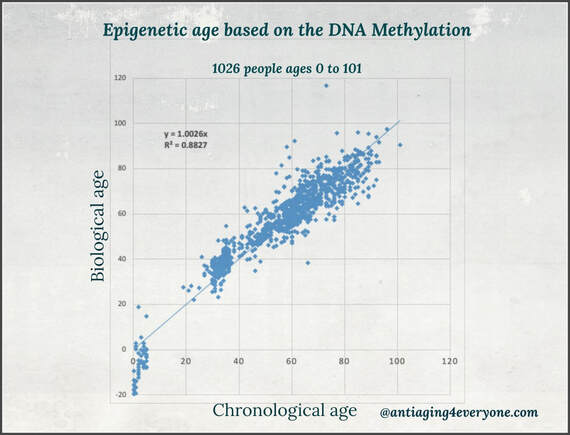
The graph below shows biological age (epigenetic age) test results of over 1,000 people. Every blue dot shows test results for one person, displaying their chronological and biological age. For the majority of the population, their biological age is close to their chronological age. 
Picture
Biological Age Estimation based on the DNA Methylation pattern. Biological vs. Chronological age. Real data from over 1,000 people is used in this model.
There are over 600 of human biomarkers of aging. What criteria are used to establish a biomarker as useful in estimating biological age in humans?
​

+ It must be possible to test it more than once and without harming a person. Click to expand or collapse

For example, a biomarker that can only be measured in the brain or inner organ cells is not a suitable biomarker. Essentially, it means that a biomarker should be detectable in representative levels in urine, blood plasma, saliva, hair or stratum corneum (the very top, outer layer of our skin). ​

​

A biomarker should also be relative easy technically to test in a laboratory.


+ It should be useful in predicting aging.

Age at menopause has been shown to correlate with longevity. One longitudinal study from Brazil (Roman, 2018) showed that women who experienced menopause between ages 50 and 54 lived longer than women who had an early menopause between the ages 41 and 44. Apart from the obvious gender limitation, it's a one time event that cannot be tested to evaluate effectiveness of an intervention.

​

Many physical and cognitive biomarkers that can predict disease and mortality outcomes have been proposed. Many of them are summarized in the tables S1, S2, and S3 of this study (Lara, 2015). Among those biomarkers are memory, verbal fluency, muscle strength etc. Such biomarkers are indeed indicative of upcoming frailty, physical and mental decline, and death. However, some of them are lagging indicators that are mostly visible after a person started exhibiting signs of aging.

As defined by the American Federation for Aging Research, a biomarker of aging should "predict a person’s physiological, cognitive, and physical function in an age-related way. In other words, it must predict the future onset of age-related conditions and diseases, and do so independently of chronological age.


+ The biomarker should trace the underlying aging process, not effects of a disease.

This may sound confusing because age and disease go hand in hand, in our minds and frequently in life.

Yet, they are two different, however closely related dimensions.

There are many drugs that can change the surface expression of disease, work on symptoms. And there are biomarkers specific to disease. A reliable and useful biomarker of aging should reflect the state and predict the progression of an aging process, for example, accumulation of senescent cells, mitochondrial dysfunction, epigenetic state.


Why do we need biomarkers? Practical application


​Personal Testing 

The practical application that we, as individuals in search of health and longevity, are mostly interested in is
individual testing to estimate our biological age or track its changes.
  • Doing a one-time test for a person can satisfy curiosity or serve as a psychological motivation. For example, we know that smoking shortens lifespan by approximately 8 years, and if a person is trying to quit smoking, they can use the test results as a wake up call to address the habit. 
  • ​Even more useful is performing repeat testing to evaluate effectiveness of lifestyle changes and encourage oneself to maintain them. For example, performing test results before changing lifestyle, such as starting to exercise or starting intermittent fasting and then performing a repeat test several months after that. 
  • Some critics deny usefulness of the biomarkers and biological age testing for the general population on the grounds that we do not have proven anti-aging therapies. That statement as such is accurate; yet it concerns "therapies" - pharmaceutical drugs and alike. There are proven lifestyle interventions. From the Baltimore Longitudinal Study of Aging to the Blue Zones, we now possess a solid knowledge of the several lifestyle factors that affect longevity and health span.
  • Further, there are promising compounds that may prove effective as anti-aging agents, such as Fisetin, Cycloastragenol, Resveratrol, Nicotinamide Riboside and Nicotinamide Mononucleotide etc. Even though there are clinical studies, in progress and published, on some of those compounds, some people may find it useful to test whether those compounds are working for them. 
​
Research & Development. Evaluation of effectiveness of anti-aging and rejuvenation therapies 
+ Read more.

Biomarkers of aging are currently used primarily in science, research, drug and therapy development. Majority of the discussions of and scientific publications on biomarkers of aging are taking place in this context. Why are biomarkers needed in that field?

An effective anti-aging therapy would slow or reverse an underlying aging process, not just have a positive impact on one part of the body or its function (e.g. cholesterol levels). A positive impact on some organ or process is not only not necessarily an indication of the slowing of an aging process, but as we know from pharmaceutical drugs impact, it may happen along with the overall health deterioration from numerous side effects.

Therefore, majority of the health biomarkers that can be tested cannot be used for evaluation of anti-aging interventions. The best available method we currently have to assess the impact of any factor, including a therapy, on human longevity is long running longitudinal studies, which are based on enrolling individuals and following them for years, until their death. As you can imagine, that is not very practical.

Biomarkers of aging would allow testing and validating effectiveness of life extending therapies without having to wait till the end of human life.


Types of biomarkers of aging

As of now, over 600 human biomarkers of aging have been discovered, and a number of recent studies attempt to systematize them. All biomarkers can be divided into phenotypic (physical, external and cognitive) and molecular (Xia, 2017; Sebastiani, 2017; Wagner, 2016). See examples below.

​Aging is a combination of multiple factors and processes and involves interaction and interrelations between biological and molecular mechanisms (Borup, 2008; Slijepcevic, 2008; Weinert, 2003). Majority of the biomarkers are specific to one of the many aging processes or to a function that declines with the age, e.g. cognitive, immune, endocrine. For this reason, in many cases scientists propose using combination panels of many different biomarkers to establish biological age as accurately as possible (Cardoso, 2018; Xia, 2017; Sebastiani, 2017; Wagner, 2016; Lara, 2015).
​
Biomarker examples - 
​
Phenotypic - cognitive, physical function, anthropometry, facial features 
Walking speed, grip strength, muscle mass, body mass index, waist circumference, eye corner slope, mouth-nose distance; verbal fluency, attention, visual memory

Molecular - metabolism, mitochondria, cellular senescence, inflammation 
  • Circulating mitochondrial DNA (causes inflammation; see Mitochondria Role in Aging); 
  • 8-Oxoguanine (a marker of oxidation DNA damage) (Gan, 2018); 
  • IgG glycosilation/glycans (immune system and inflammation) ;​
  • Beta-Galactosidase (one of the most widely accepted and extensively used biomarkers of cellular senescence) (Spazzafumo, 2017); 
  • The level of hormones: growth hormones, sex hormones (testosterone and estrogen), HAP axis, growth hormone IGF-1, melatonin, thyroid hormones, adipokines (Lara, 2015);
  • mTOR signalling gene expression (Passtoors, 2013).
​
Molecular - DNA based. The most accurate ones
  • Telomere length. Telomeres are protective caps at the end of chromosomes; they shorten with each cell division.  (Kimura, 2008);  
  • DNA Methylation Patterns and Epigenetic Clocks (Field, 2018)

The most accurate biomarkers that we can test at home to estimate our biological age

Using panels of molecular biomarkers involves - 
  • for the molecular biomarkers - taking a blood sample and performing numerous laboratory analyses;
  • for the phenotypic ones - administering and analyzing test results.
That may be feasible in clinical and laboratory settings, but not at home.
The most accurate at-home tests of the biological age that are based on one biomarker only are -
  • Telomere length, and
  • Epigenetic age based on the DNA methylation levels. 

A sample of blood or saliva is collected at home into a kit supplied by a testing company. The person mails back the sample. Results are analyzed in a laboratory. 

Biological Age Test - Telomere Length

The history of our knowledge of telomeres begins with the American anatomist Leonardo Hayflick who in 1960-s discovered that cells cannot replicate indefinitely and proposed that that must be a mechanism behind our aging. He was followed by the Russian biologist Alexei Olovnikov, who discovered shortening chromosome ends and proposed the telomere shortening theory of aging. 

​Telomeres are protective caps at the end of chromosomes; they shorten with each cell division. When telomeres becomes critically short, a cell enters the state of replicative senescence. If a cell stays in that state of senescence, it damages its surroundings. Alternatively, a cell commits a suicide, called 'cellular apoptosis', for the 'greater good' of the tissues and body.
Shorter telomeres correlate with an increased risk of morbidity and mortality. 

Telomere tests estimate a person's biological age by determining the length of a person's telomeres in relation to that person's age.

Biological age test -
​Epigenetic clocks based on the DNA methylation levels


​Our genes are 'set in stone' but not their expression and influence on our health. 
Epigenome is a set of chemical compounds attached to our DNA or to histones, around which DNA is wrapped, that tell our genome what to do and is ultimately responsible for how our genes are expressed (Epigenomics Fact Sheet, 2016).
  • Genome (genes) made of DNA is the master instructions for our bodies. Every cell in an organism has the same genes;
  • Epigenome is the instructions that dictate which parts of the master code are to be read and used in a particular case (which genes will be expressed). 
Epigenome performs its functions via two molecular mechanisms: histone modification and DNA methylation. 
Epigenome - roles and mechanisms 
​Epigenome roles - 

1. Accommodate the variety of cells and tissues built off the same genes in an organism.

The first and obvious function of the epigenome stems from the variety of cells and tissues in our bodies, all of which have exactly the same genome. The differences between a red blood cell, a neuron (brain cell), a muscle cell, a skin cell etc result from when and how different genes in their nucleus are turned on or off. The epigenome establishes many of these differences. 
​

2. Environmental adaptations within the lifespan of one organism.  
​The second role that epigenome plays is the environmental response, an adaptation to the conditions of an organism's immediate environment. Evolution takes thousands of year to produce a stable and inheritable genetic change in response to the environment. An epigenetic change allows responding within a single lifespan.  
Latest scientific research shows that epigenome is partially heritable, and can be changed in response to environment, lifestyle, disease, nutrition, early childhood experiences. ​​​

Epigenome performs its functions via three distinct mechanisms - 

1. Histone modifications, that control gene expression indirectly. Histone proteins are structures, around which long DNA molecules are wrapped creating the chromosome shape. Various chemical tags indicating if that DNA region should be ignored or used can be attached to the histones. Other proteins can sense those histone modification tags. ​
​
2. DNA Methylation, impacts DNA in the genome directly.
Methyl groups can attach to DNA in various places of a genome (the term is "DNA methylation') creating 'tags' or 'on-off switches' for the genes. 
​Those methylation tags create patters that change throughout life. The methylation patterns and their dynamics have been found to change with the age. 

3. RNA-mediated gene silencing (Holoch, 2015). 
Back in 1960-s, Russian scientists have discovered that global genomic DNA Methylation decreases with age (Berdyshev, 1967).
Fast forward to the present time, DNA Methylation Patterns and Epigenetic Clocks are among the best studied and most reliable biomarkers of aging. 

​Throughout our lives, DNA methylation changes in the following way -
  • ​Overall DNA methylation decreases;
  • ​Particular DNA methylation on and off tag patterns change. Some sites become hyper-methylated.
By looking at the pattern of the DNA methylation, we can tell how old a person is biologically. Utilization of this biomarker of aging became possible only recently as it requires application of not only mathematical models, but also advanced laboratory analysis and computer technologies. 

As of 2019, the epigenetic markers of DNA methylation are the most precise biomarkers of aging when used alone. 
The test for estimating biological age based on the DNA methylation became known as 'epigenetic clock'. The method and the term were pioneered by Steve Horvath (2013), and his clock is known as 'Horvath clock'. 


As of 2019, several epigenetic clocks have been developed and some of them have been developed into consumer tests - 
  • Horvath (2013) (Horvath, 2013-2015; Horvath, 2018),
  • Hannum (2013) (Hannum, 2013)
  • Weidner (2014), (Weidner, 2014)
  • and the latest one, by one of the pioneers in the field of epigenetics and cancer research, Dr. Szyf. Szyf and his team developed the epigenetic clock out of the cancer research and research on how early childhood experiences influence epigenetic changes and subsequently impact health, both physiological and, interestingly, psychological, throughout life. 

The biological age test based on the epigenetic clock developed by professor Szyf can be ordered here. You can use the discount code antiaging4everyone to get 10% off that test.  

Limitations and interpretations of the biological age test results


​Keep in mind the following limitations and considerations on interpreting biological age test results - 
  • Sometimes a technical error may occur during a laboratory testing. Mary Armanios, Professor of Oncology and Clinical Director at the Telomere Center at John Hopkins, recently gave an example: a 39-year old person contacted her. He received telomere test results from a direct-to-consumer company. The test results told him he had telomeres of an 80 year old person, and based on the test results, the gentleman was considering selling his house and retiring. He was retested at the John Hopkins, and his telomere results came back showing that he was well above the 10th percentile for his age group. If my results came back with test results showing my biological age drastically different from my chronological age, I would do a repeat testing, maybe with a different company and/or of another biomarker(s) all together.
  • With respect to the telomere length testing, unusually long telomeres are not necessarily 'good' (a sign of truly slow aging and excellent health). Sometimes very long telomeres are associated with disease. 
  • Results of a biological age test based on a biomarker of aging will not predict a person's susceptibility to a particular disease, rather an overall state of health.
  • Results of an epigenetic age test based on the DNA methylation levels are not a verdict. We can change our epigenome and epigenetic age through lifestyle interventions.
  • Finally, obviously, testing your biological age does not make one younger. It is an information tool that helps finding out whether a person is aging well and assists in monitoring impacts of lifestyle changes or other anti-aging interventions. 
Table of Content for the publications cycle
In the previous publication - Biological and Chronological Age
​
In the next publication - Epigenetic Clock and DNA Methylation Biomarkers of Aging - coming soon 
References and Literature for the publications cycle "Biological Age and Biomarkers of Aging'
Terms of Use - Legal
AntiAging4Everyone (c) 2020
  • Site Map
    • Contact and About >
      • Get in touch
  • Publications
    • Blog >
      • Let's Put the COVD-2019 in perspective
    • Reasons why we age >
      • Aging Reasons
      • Telomere Shortening and Cellular Senescence
      • Mitochondrial Decline
    • Biological Age and Biomarkers of Aging >
      • Biological and Chronological Age
      • Biomarkers of Aging
      • Epigenetic clocks and epigenetic age
    • Anti-Aging Supplements >
      • Vitamin C
      • Ubiquinol - for mitochondria and more
      • Fisetin
      • Bone and Joint Health Supplements
  • Private Consultation Request Form
  • NEW HOME DRAFT